


📢📢📢 ANNOUNCEMENT! Starting today, Substack’s paid subscriptions are enabled BUT everything will stay free!
(Ellen, we went over this last time…that’s not how “paid” works)
But it is! Think of it as a “buy me a coffee” or a tip jar.
I turned on Substack’s paid subscriptions feature because the platform favors publications that use it and I’d like more people to find this newsletter BUT everything stays free. No tiers, no withheld access. But if you’ve ever wanted to say keep going, this matters to me, now you can.
Whether you pledge or not, your readership is what matters most to me! 📢📢📢
💬💬💬 With that, here is this week’s COMMUNITY CHAT: Which one do you have the tendency to do when you’re feeling lonely or anxious: come on too strong, or pull away? (No judgment, I’ve done both 😬) CLICK BELOW TO JOIN! 💬💬💬

And now, on to the newsletter!
Hi everyone!
When I was a new mom, I belonged to a mom-and-baby support group through a local parenting center. At the end of one meeting, one of the other moms made an announcement, inviting everyone to her house for a playdate. I had only talked with her a couple of times at that point, but all of us were in the process of figuring out how to make mom friends, so I went.
Three of us showed up. She met us at the door before we had a chance to ring the bell. She ushered us into a spotless living room, seated us in a neat row on the couch, and promptly handed each of us a plate of snacks and a glass of sparkling water from the spread on the coffee table she had clearly worked hard to arrange. There we sat, a glass in one hand, a plate in the other, and respective babies propped on our laps. We looked at each other. The babies squirmed. She sat in a chair across from us and broke the conversational silence, leaning forward. “So, we can do this regularly?” Before anyone could answer, she added, “Every week?”
I felt for her. She was new-ish to the U.S., with an American husband who, based on her disclosures during the support group, didn’t seem particularly attuned to her needs.
I could tell she was lonely: the diligent preparation, her eagerness for us to commit to a regular cadence, the sense she had rehearsed for our visit. She really wanted it to go a certain way and it made sense why.
In response to her question, we all said something polite but non-committal. For me, I knew that accepting would have been disingenuous. I felt guilty, but after the parenting group concluded, we didn’t stay in touch.
The memory of her has stayed with me for almost eighteen years. I wonder what happened to her. Did she find her people? Did she make some friends?
We all get a little awkward and desperate when we’re lonely. It’s not a character flaw or a sign of poor social skills; it’s biology. For social animals (like, say, for example, humans), loneliness translates to the brain as a lack of safety. The tribe isn’t there for us, perhaps physically, perhaps emotionally.
And then we get a little weird. Generally, this can go one of two ways:
Either we try too hard. We shift “approach” into overdrive.
Or we withdraw. We shift “avoid” into overdrive.
Then, when we start to act weird, whether we’re retreating or coming on too strong, people react negatively because we’re acting weird, our fears are confirmed, and round and round we go.
Add in some social anxiety and it gets amplified as if with a megaphone.

Worst of all, it’s rare to get honest feedback that we’re coming on too strong or giving up too quickly. Too often, we’re left to figure it out ourselves.
This week, we’ll cover how to check in with yourself about whether your social signaling matches your intentions.
We’ll start with variations of coming on too strong. Here are some of the well-intentioned but ineffective things I’ve seen (and done!) as a result of feeling unsupported or lonely, plus low-lift ways to try something different.
Trying too hard to be likeable
I’ve certainly been guilty of this one. Normally, my face naturally matches what I’m talking about, but when I’m having a social anxiety spike, I tend to slip into a flight attendant perma-smile. Sometimes, I catch myself smiling when I’m talking about topics that don’t go with smiling, like recurring joint pain or my broken microwave. When I see a flash of puzzlement in my conversation partner’s eyes, I catch myself and try to recalibrate.
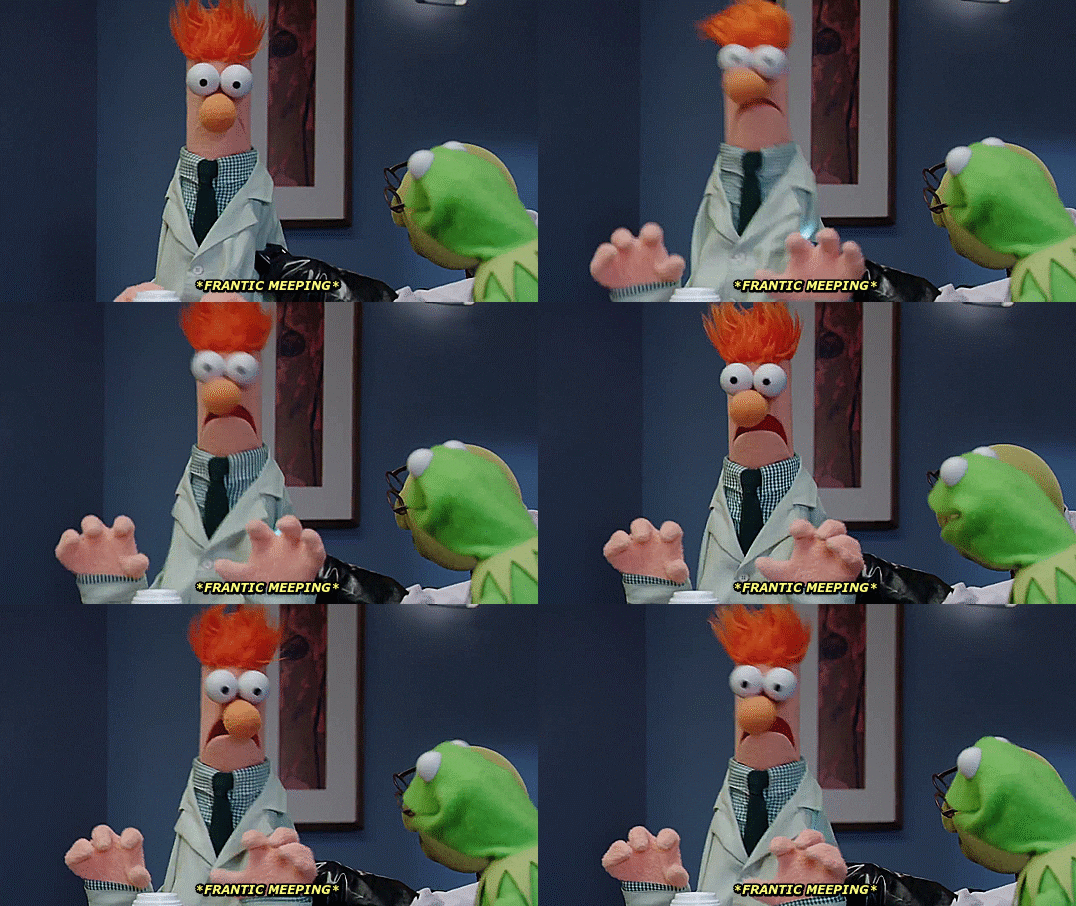
With clients, I’ve heard about forced peppiness (one woman confessed she caught herself actually using jazz hands in conversation), frantic enthusiasm, or active listening skills on overdrive: think vigorous nodding and agreement without regard to what’s being said.
However trying too hard to be likeable manifests, it’s driven by a visceral drive to connect, which is oh-so-human of us. Of course we want to be liked. And of course we’re willing to try hard if we’re feeling lonely.
But if our trying to be likeable gets read as intense, incongruous, or disingenuous, our conversation partner’s natural reaction is to withdraw. It’s a common pattern: demand, withdraw, demand, withdraw.

A small shift to try:
Read and roughly match the energy of the person or group you’re talking to. The goal isn’t to mask or be fake—indeed, when we try too hard, we’re also offering an insincere version of ourselves—but to ground ourselves in the moment.
Focusing on the here and now relieves the urgency of working so hard, whether it’s to be liked or to avoid being judged or rejected. In other words, tuning into what is takes the pressure off what should be.
Trying too hard to behave perfectly
This is qualitatively different from trying too hard to be likeable. It’s more a sense of having to earn connection through good behavior.
Growing up, most of us learned how to be polite and behave appropriately. This is great. Please keep doing that.
But some of us absorbed the lesson, usually as a child, that good behavior makes adults like you.
So we followed that lesson to its natural next step: if good behavior makes people like us, exemplary behavior must make people like us even more.
There are at least two problems with this. One is that good behavior will only take us so far. You are not friends with your friends because of their appropriate behavior; more likely, you are friends with your friends because when you’re with them, you feel like you can be yourself and don’t have to perform at all.
Second, behaving perfectly can come across as overly formal, as if the point of hanging out is performing the rules of etiquette as opposed to connecting. And formality creates distance, which is the last thing we need when we’re lonely.
For example, a client we’ll call Nicky was going through a breakup. She didn’t want anyone to perceive she was gossiping about her ex behind his back, but that meant when her friends asked after her, she gave vague, careful answers and then changed the subject. She had meant to be polite, but her signaling read as: I don’t need your support, which amplified the loneliness of ending her relationship.

A small shift to try:
Complain a little. Ask for advice. Ask for support.
This can be a tough sell to those of us whose politeness functions as a defense, even as we yearn for connection: “Look how nice I am; don’t hurt me.”
But consider your signaling. Is behaving well actually getting you the loneliness-busting connection you want? If not, consider this: sharing a little bit of the mess signals to others that you trust them, which may be more effective.
Six months after the breakup, Nicky decided she could avoid gossip while sharing her own experience. She started filling her friends in on what happened, and one of them actually said, “Nicky, I feel like our friendship just reached another level.”
So, by all means, be polite! Heed the lessons of your childhood! But stop short of being overly formal or solicitous, which can read as closed.
Dominating social interactions
Our final iteration of “trying too hard” manifests as overeager interrupting, talking over people, nervous-chatter monologuing, and the like.
Here’s what sometimes happens: a nervous chatterer will unknowingly irritate, overwhelm, or lose the listener. The listener hangs in there to be polite, but at some point breaks it off: “Oh, look at the time! Gotta go!”
But the lesson that gets absorbed is: when I stop talking, I lose the connection.
Self-aware chatterers might realize the effect they’ve had on the listener. But then they feel shame. And then the lesson is: when I stop talking, I feel bad about myself.
Either way, the take home is: keep talking, which backfires and keeps us stuck.

A small shift to try:
How do you know if you’re actually connecting, or filling the space with nervous chatter? Awareness is the key. If you know you tend to be chatty, what does it feel like in your body?
Talking can be driven by connection—you like each other, you’re both vibing, you both have a lot to say. Connection feels like safety. It might feel like warmth or openness. Physiologically, our shoulders, face, and jaw relax.
Talking can also be driven by anxious loneliness. Nervous chatter often feels like an audition. We might feel breathless, hyperfocused, or tight in the chest.
So tune in to whether you’re connecting or nervous chattering. Adjust accordingly, and be kind to yourself in the process.
To wrap it up, it’s so easy to slip into an accidental social drought of loneliness: a move, a nose-to-the-grindstone semester, the all-in of caregiving, a breakup, the realization a job or relationship has become all-consuming. My fellow parenting support group mom faced a double whammy: immigrating to a new country and caring for a newborn.

Finding our people can be tough, especially when we’re already not feeling our best due to loneliness or social anxiety.
The good news is that none of our off-kilter social signaling is permanent. Signals can be adjusted. The first step is to catch ourselves jazz-handing or nervously monologuing or over-hosting a playdate, but that means self-awareness has already done a lot of the work. All that’s left is to experiment with something a little different.
Be good to yourself,

**As always, all HIPAA identifiers and story details have been changed or combined while keeping the essence intact. My goal is to honor the confidentiality of therapy while sharing relatable, based-on-a-true-story examples.


