
💬💬💬 This week’s Community Chat, apropos to our topic: “What’s one job requirement you didn’t meet, but you applied to the job anyway?” CLICK BELOW TO JOIN! 💬💬💬

📋📋📋 Are you and your partner each other’s social life? My friend Anna Goldfarb, author of Modern Friendship, is researching the phenomenon of couple isolation: couples who, deliberately or accidentally, shrink their social world down to just the two of them. If this feels familiar, would you share your experience in a 10-minute survey? 📋📋📋
And now, on to the newsletter!
Hello everyone!
Dear reader Marissa is looking for a job.
In this economy? That’s hard enough.
While AI eats up jobs like the dots in Pac Man? That’s even harder.
And when we’re wired to be perfectionistic? That’s the hardest of all.
Marissa writes:
I am a perfectionist who is looking for a job. As you might anticipate, this is a recipe for disaster. I am definitely the person who reads the job description and says “I do not excel in all those skills so I am obviously unqualified.” As an added insult to injury, I am also extremely hard on myself during and after interviews, ruminating on all the ways I feel like I did not live up to their expectations. Then when I never hear back, it validates my hypothesis that I am indeed unqualified and lacking in some way; otherwise wouldn’t they have hired me? My inner critic is a real bummer.
First of all, any company would be lucky to have you, Marissa! Since you are perfectionistic, you have the #1 trait that all employers are looking for: conscientiousness. You’re diligent, responsible, and want to do things well. You’re exactly who employers want!

Despite all that, perfectionism makes us doubt our qualifications, kick ourselves when we think of a better answer after the interview, or take things personally (at least a little) when we get passed over.
Let’s go through Marissa’s question point-by-point. First up:
“I am definitely the person who reads the job description and says, ‘I do not excel in all those skills so I am obviously unqualified.’”
Consider this: Treat your perfectionism like a golf handicap.
The perfectionistic brain automatically compares our skills with the level of skills we think the employer is looking for and comes up with a gap. However, if we know we assess ourselves harshly, we can account for this when we’re reading job descriptions, like a golf handicap. Or academic accommodations, like extra time on a test for dyslexia. Account for your perfectionism, and then re-assess the gap: “I think I only meet 80% of the qualifications, but some of that is probably my perfectionism talking. I bet I’m actually at 90-95%.”

Consider this: Approach the job description as a wish list, not a check list.
Job descriptions aren’t carved in a stone tablet. People who write job descriptions—hiring managers and HR reps—are people, and people notoriously aren’t very good at knowing what they really want.
They may write a job description as a wish list for a dream candidate, but rather than holding out for a perfect match, they hire for a close-enough fit and trust that the rest can be learned on the job. The job descriptions often soften or morph once real people start to apply.
Consider this: 100% qualification might mean overqualification.
Getting hired for a job you can do 100% from day one means there’s no way for you to learn, grow, and build your career. If you meet 100% of the job description, you may wish to aim higher.
Next up, Marissa writes:
“As an added insult to injury, I am also extremely hard on myself during and after interviews, ruminating on all the ways I feel like I did not live up to their expectations.”
Consider this: Zoom out. Use a metaphorical full-length mirror to inspect, not a magnifying mirror.
Everyone has said something dumb in an interview. All of us have thought of a much better answer after the interview concludes and we’re on our way home.
But those of us familiar with perfectionism feel this 100X harder.
Here’s an analogy—stay with me. Those of us with detail-oriented perfectionistic brains inspect our interview answers as if with one of those magnifying makeup mirrors. We zoom in tightly on small details—a weird pore, a stray eyebrow hair—or, in the case of interview answers, an incomplete thought, a moment of confusion. Either way, we focus on small flaws. And then we get self-critical because all we’re focused on is flaws.
By contrast, try to reflect on your interviews as if with a full-length mirror. Get an overall sense of your reflection. Look at the whole picture.
If you zoom in, you will find flaws. Keep your observations higher-level rather than letting the inevitable flawed details color your whole assessment.
In addition, turn the tables: when you interview someone, do you judge them based on whether or not they reached their highest possible potential on every answer? More likely, you judge them based on the overall vibe of their character, experience, and fit.
Therefore, when you’re the one being interviewed, keep your sense of “how it went” equally zoomed out and holistic.
“Then when I never hear back, it validates my hypothesis that I am indeed unqualified and lacking in some way; otherwise wouldn’t they have hired me?”
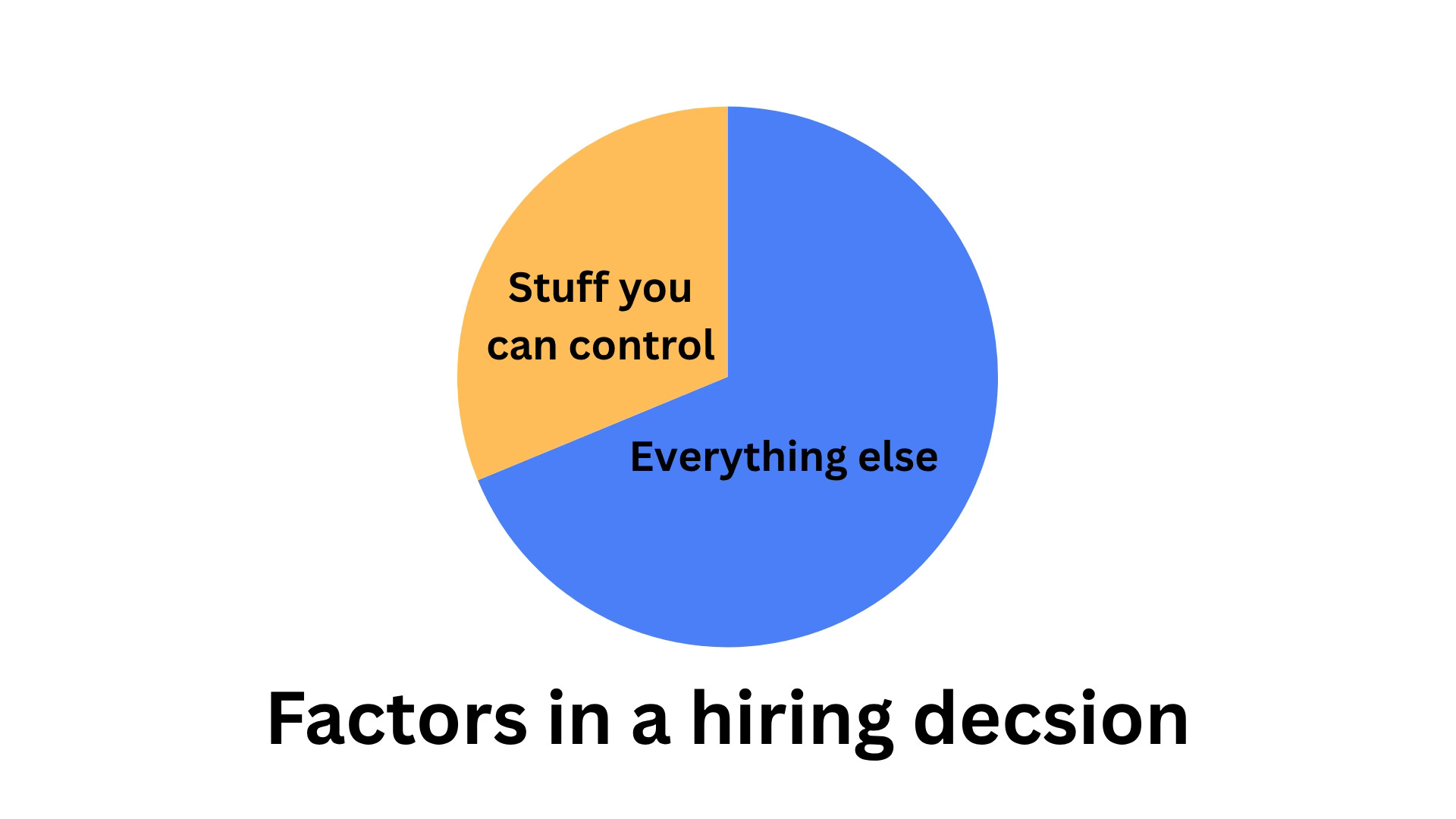
Consider this: Remember that hiring is an imperfect system at best, a crap shoot at worst. Control what you can control and radically de-personalize the rest.
Why does one person get hired over another? Qualifications, yes. But also a zillion other factors. These factors might be subjective, like the ever elusive “fit.” They might be uncontrollable, like whether or not your most glowing reference actually answers the phone. Or they might be situation-dependent, like a well-liked internal candidate. There are also more nefarious factors, like cronyism and discrimination.
The list goes on and on.
But that’s the point.
You can control some of the hiring decision by targeting jobs that seem to match your background and skills, jumping through all the hoops of the application process, and making sure you don’t have chia seeds in your teeth before the interview. But that’s about it.
Control what you can, and radically de-personalize the rest.
All in all, Marissa, and all of us who find ourselves on the job market in these anxious times, may wish to gently tweak our hypothesis from: “If I am not hired, it must be personal: I am unqualified and lacking in some way,” to something more along the lines of, “If I am not hired, something unknowable happened. This is a numbers game.” And send out the next application.
Be good to others and yourself!