4 reasons we anxiously over-share, plus how to stop
Also, the fine line between vulnerability and oversharing.

An anonymous reader wrote in after my newsletter encouraging vulnerability and noted that she has the opposite problem. Instead of reticence, she rambles. She chatters anxiously and ends up sharing too deeply, too quickly. Then, as she writes, “I will be disappointed and feel rejected.” She hypothesizes: “I was too eager to create friendship.”
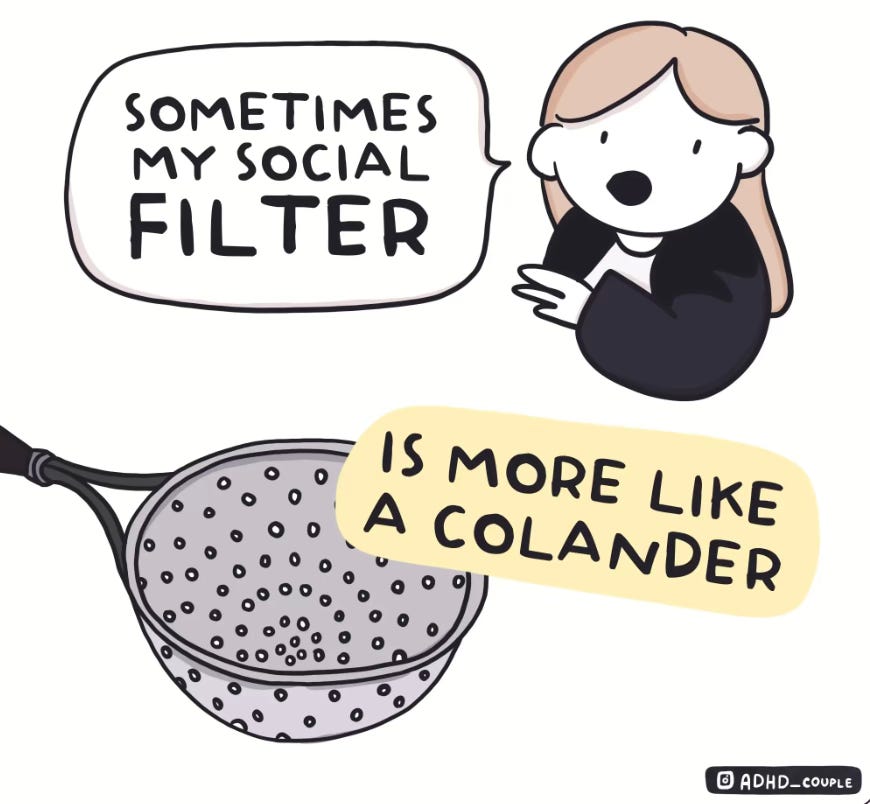
In general, personal disclosures build connection. Telling someone about yourself signals that you like and trust them. It’s cliche, but sharing is caring, so sharing bits of your life demonstrates your care and investment in the relationship.
But sometimes we do too much of a good thing: a conversation partner’s averted eyes and sudden awkwardness tell us we’ve shared too much, too soon, leaving them unsure how to respond. Or we might chatter nervously to fill the space and realize we’ve said more than was prudent.

And then? We fill the awkwardness with even more babbling. We slip on the very banana peel we dropped in the first place. Indeed, anxious over-sharing can leave everyone feeling uncomfortable—you and your conversation partners.
Why are we like this? Why do we overshare when we’re anxious?
Great question. There are lots of reasons, but here are four:
One: Our bodies’ revving makes us start rambling.
One theory posits that physiological activation increases social transmission—in other words, when our bodies are “go,” oversharing follows.
Research bears this out: people share more when they experience energized, high-activation emotions, like anxiety or amusement, than when they experience slower, low-activation emotions, like sadness or contentment.
Therefore, when our engines are revving with nervous social anxiety? Gentlemen, start your babbling.

Two: Eagerness to connect makes us share too much, too soon.
Loneliness or disconnection can drive us to overshare as a beeline to connection. Oversharing can give us a shot of closeness even in the shortest of interactions. Question: “Why did I cry to the checkout clerk about my breakup?” Answer: To buy yourself a little (non-sexual) intimacy, something every human needs.
Or, like our anonymous reader, we may simply go a little overboard. Connection is a human drive and eagerness is totally understandable.
Whatever our reasons, our desire to connect might prompt us to share vulnerably in contexts where it’s not yet appropriate.
Three: Social anxiety can lead to compulsive confession.
If social anxiety makes us anticipate rejection or disinterest, or we perceive we’re failing to live up to social standards, we may drop a vulnerability bomb in order to re-engage our audience. We may lead with a shocking story to ensure no one thinks we’re boring, awkward, or have no personality.
Four: Social anxiety takes up all of our bandwidth, so we end up babbling mindlessly.
The heart of social anxiety is perfectionism. We think we have to come across as smart, funny, cool, or at least not hopelessly awkward. We create a lot of rules for ourselves: Don’t be weird. Don’t be cringey. For pete’s sake, don’t overshare. But then social anxiety uses all our brainpower, and we’re left with just enough left over to ramble and babble and say all the stuff we didn’t mean to say.

To top it off, when we have to remember what not to do, we end up thinking about it, and then—ta-da!—we do it.
What’s the most important difference between vulnerability and oversharing?
I’m glad you asked: vulnerability is selective; oversharing is indiscriminate.
When we take a risk by sharing a vulnerability, we’re signaling “I like you and trust you” to a chosen person or group. We’re deliberately revealing parts of ourselves that are hidden, embarrassing, or shameful in order to be known and seen by these particular people. We want to be closer to them in particular.
By contrast, oversharing is indiscriminate. The audience for our overshares are interchangeable—it could be any warm body: the girl we just met at a party, the Trader Joe’s cashier, the office gossip who will probably use this against us.
Okay, Ellen, but how do I stop?
How do I avoid oversharing?
Great question. Here are three things to try:
One: Consider your context.
The beach is a great place to go shirtless, but the office? Not so much. Likewise, disclosure isn’t one-size-fits-all. I know it’s hard to think through the buzz of anxiety, but do your best to consider your context.
Is the person you’re sharing with someone you’d like to be closer to?
Has sharing been reciprocated or are you the only one baring your soul?
Are you at the point in your relationship where your disclosure is the next step into the metaphorical swimming pool? Or are you doing a cannonball off the high dive right away?

Two: Focus on what you want to be doing.
When we overshare automatically or reflexively, we do so mindlessly. As I like to say, your attention is a spotlight and you get to choose where to point it. Point your attention on what you want to be doing: listening for relatable parts of your friend’s lost luggage story, playing Subjective Guess Who?, or recounting your wilderness backpacking trip and weighing whether or not to talk about how you dealt with going #2.
Three: Connect by listening.
Sharing isn’t the only way to connect. Listening is a powerful connector. Bonus: a lot of us with social anxiety are good at this one. Indeed, in the attention economy of 2024, making someone feel heard is a true superpower.
My new book, out in January, How to Be Enough: Self-Acceptance for Self-Critics and Perfectionists, covers everything we talk about in this newsletter: the overlap between anxiety and human connection. Pre-ordering sends a message to bookstores and publishers that books like this on mental health and human connection are needed and important.
Would you do me a five-second favor? If you’re on Goodreads, please add it to your “Want to Read” list. It’s the green button just below the picture of the book cover. I appreciate you!
If you received this newsletter from a friend, sign up for more (hey, there’s a button right there) or at ellenhendriksen.com.
Be kind to others and yourself!